The enforcement of patent rights raises complex, and, from a private international law perspective, unique difficulties. Since intellectual property practitioners started to seek the consolidation of cross-border patent disputes, the interplay of private international rules has led to drastic changes in patent litigation across Europe. This book analyses in detail both the European rules on jurisdiction (the Brussels Convention and its successors) and the choice of law rules as they apply to cross-border patent disputes, and will be essential reading for both intellectual property lawyers and international commercial litigation specialists.; At the jurisdictional stage, the basic question is whether the current jurisdictional framework provides a basis for the concentration of related litigation. For jurisdictional purposes, patent enforcement is a tort. Accordingly, cross-border patent enforcement attempts may generally be undertaken at the forum of the defendant’s domicile, the place of the tort, and, as far as provisional measures are concerned, another forum with a sufficient connection to the dispute. On the other hand, the application of the current jurisdictional framework to international patent infringement disputes leads to significant difficulties such as the pre-emptive effect of proceedings pending abroad or the jurisdictional consequences of a patent validity challenge.; At the choice of law stage, this book provides a comparative overview of the rather unexplored issues arising in multinational patent enforcement. De lege Fernanda, it seems that, because of the territorial nature of patents, a distributive application of the law of the protecting State (lex loci protectionis) appears to be the most consistent choice of law rule.
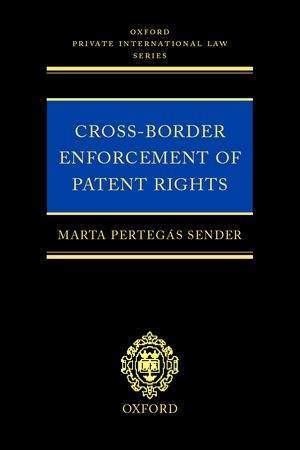
Cross-border Enforcement of Patent Rights
RM190.00
By: Marta Pertegas Sender
ISBN: 0199249695, 9780199249695
Published: September 2002
Country of Publication: UK
Customer Reviews
There are no reviews yet.
Only logged in customers who have purchased this product may leave a review.
Related products
-

Digital Copyright Law of Malaysia
RM171.00Author: Dr Sik Cheng Peng
Published: Jan 2020
ISBN: 9789672339304
Print & Proview eBookRM190.00 -
ATTACHMENT OF PROPERTY AND ITS REMOVAL
RM131.30* 1 COPY LEFT
When Court can issue order at Attachment of Property of absconding person under Section 83 of Cr PC?
Moreover in order to issue an order of attachment of property of person absconding under Section 83 of the Cr PC, the Court issuing a proclamation under section of the Cr PC may for reasons to be recorded in writing at any time after the issue of the proclamation, order the attachment of any property movable or immovable, or both belonging to the proclaimed person, provided that the Court is satisfied that the person in relation to whom the proclamation is to be issued; (a) is about to dispose of the whole or any part, of his property or (b) is about to remove the whole or any part of his property from the local jurisdiction of the Court. Only on satisfaction of such condition, the Court may order the attachment simultaneously with the issue of the proclamation.
-
Copyright Law for Librarians and Educators: Creative Strategies and Practical Solutions, 4th Edition
RM458.70Author: Kenneth D. CrewsISBN 13: 9780838916292Publication Year: 2020
Format: Paperback
Country: USA“Straightforward … a terrific way to teach library students a lot in an easy to read book.”
—Lesley Ellen Harris, author, educator, consultant, Copyrightlaws.com -
Intellectual Property Law in Malaysia, 2nd Edition
RM342.00This book is a detailed work that gives a distinctively Malaysian account of the six areas of law that are conventionally accepted as falling under the rubric of intellectual property: the law of passing off, registered trademarks, copyright, patents, registered industrial designs and confidential information. It provides a basic but comprehensive account of the substantive rules that govern these areas of intellectual property law, with the focus being essentially on the Malaysian position. In treating intellectual property law as a coherent whole, this book enables the inter-relationship and the similarities that exist between the different areas to be better appreciated.In addition to the thorough survey of local law, references have been made to case law from foreign jurisdictions where uncertainties arise in the local position. This provides a different perspective on possible approaches that may be applicable in addressing the local issues. In the areas which are governed by statutes, an outline of the historical background, justifications for protection and the international influences that have shaped those areas are provided so as to convey a better understanding of the nature of the law of intellectual property.Written by an experienced teacher and researcher of intellectual property law, this book provides clear analysis and discussion of the law, supported by copious citation of authorities. This new edition is fully up to date, taking into account new case law and statutory developments.New in this editionAnalyses the legislative and judicial developments in Malaysian intellectual property law since the first edition of the book.Incorporates key developments in the international protection of intellectual property.Details the progress of the ASEAN Intellectual Property Cooperation.Explains the trademark registration process under the Madrid Protocol.Includes new chapters on registered trademark law under the Trademarks Act 2019.Discusses the scope of the Copyright (Amendment) Act 2020 and judicial decisions that clarify important copyright principles.Highlights the impact of significant patent law decisions handed down by the Federal Court and the Court of Appeal.Contains ProView Extra materials available exclusively in ProView eBook only.RM380.00 -

Law On REITs In Malaysia
RM160.00Author: Seow Hock Peng
ISBN: 9789674571641
Pages: 368
Format: Paperback
Publication Year: 2022 -
LexisNexis Essential Reference – Intellectual Property (Trademarks)
RM250.00Authors: LexisNexis
Publisher: LexisNexisThe registration of trademarks in Malaysia is governed by the Trade Marks Act 1976 and Trade Marks Regulations 1997. Registration of a trademark conveys exclusive rights to the registered proprietor to use the mark on the goods or services for which the mark is registered. A trademark registration is valid for ten years and it is renewable. A trademark owner can be an individual, business organisation or any legal entity. Any mark proposed to be used in relation to goods or services to indicate a connection in the course of trade between the goods or services and the person having the right to use the mark can be registered.
-

Ambush Marketing and Brand Protection Law and Practice Second Edition
RM870.00ALL PRICES ARE SUBJECT TO CURRENCY FLUCTUATION. PLEASE CALL IN FOR PRICES.
- The only book specifically focussed on the protection of major event sponsorship and laws to control ambush marketing
- Detailed treatment of the laws relating to ambush marketing in the UK and other jurisdictions including the US, Australia, New Zealand, Canada and South Africa, as well as some European countries
- Invaluable guidance for brand owners and their legal advisors on how to protect their brand and their investment in sponsoring major events
New to this Edition:
- New chapter examining the principles and common clauses in sponsorship contracts as well as the differing types of sponsorship relationship
- Covers recent developments including concerns about the distinctiveness of marks such as ‘WORLD CUP’ and ‘LONDON 2012’
- Considers recent cases relating to the filing of marks in bad faith, trade mark use, the meaning of taking ‘unfair advantage’ and the meaning of ‘detriment’ in relation to dilution
- New section on the Company Names Adjudicator
- Increased geographical coverage
Ambush marketing is any attempt to create an unauthorised or false association with an event thereby interfering with the legitimate contractual rights of the event’s official marketing partners. Looking at both traditional intellectual property rights (such as trade marks, copyright and designs) as they relate to sporting events, and event-specific legislation (such as that of the Olympics), this book gives comprehensive and detailed coverage of ambush marketing. Also considered are the areas of law which can be used to prevent ambush marketing by intrusion (such as laws to prevent fly postering, street trading, the placing of posters and billboards, and control of aerial space). With the United Kingdon hosting three major events; the Olympic and Paralympic Games in 2012; the Commonwealth Games in 2014; and the Rugby World Cup in 2015, this new edition provides a timely and topical update on the area. A materials section is included providing ‘ambush marketing’ specific legislation both in the UK and other countries.
Table of Contents
Part A – Ambush Marketing, Concepts, Developments, and Incidents
1:Ambush Marketing
2:The Evolution of Ambush Marketing Laws
Part B- Ambush Marketing: United Kingdom and European Union Law
3:Trade Marks and Merchandising
4:Passing Off, Copyright, and Decisions and Related Rights
5:Symbols and Emblems
6:Sui Generis Protection against Ambush Marketing By Association
7:Licensing, Broadcasting, and Exhaustion
8:Advertising and Trade Regulation
9:Selling Tickets or Using them for Promotional Purposes
10:Civil and Criminal Proceedings and Border Control
Part C: Ambush Marketing: Laws around the World
11:Australia
12:Canada
13:New Zealand
14:South Africa
15:United States -
CONFIDENTIAL INFORMATION LAW IN MALAYSIA
RM310.00This publication provides in detail the law of confidential information which protects information including opinions and ideas that are precluded by copyright and other statutory regimes. The law of confidential information provides valuable protection not only to personal, commercial or industrial information but also to governmental or administrative information. This law has its importance particularly in the area of trade secrets and business information and gives protection to information that is not released to the public or part of the public domain. It also provides a basis of action for protection of privacy.
The publication further explains in great detail the aim of the particular area of law concerned, i.e. to act as a safeguard from exploitation of trade secrets, encroachments of privacy, misappropriation of confidential information without just cause and excuse and to protect national security and the government’s integrity. It protects both the owner and its secrets based on an equitable principle, that those who receive confidential information should not take advantage of them to the detriment of the confider or the owner of the information.
The publication also provides commentary on cases pertaining to the subject matter, with reference to the United Kingdom, Malaysia and other relevant jurisdictions.