- International perspective: written by judges and leading academics from the US and Europe
- Focus on intellectual property rights as a whole: with an emphasis on the common theoretical underpinnings of copyright, patent, and related rights (trade secrets, contract rights)
- Identification of expanding rights as a trend that has important and novel pro- and anti-competitive implications
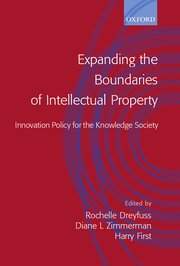
Expanding the Boundaries of Intellectual Property
RM50.00
Author: Rochelle Dreyfuss, Diane L. Zimmerman, and Harry First
Published: 29 March 2001
Customer Reviews
There are no reviews yet.
Only logged in customers who have purchased this product may leave a review.
Related products
-

LexisNexis Essential Reference – Intellectual Property (Trademarks)
RM250.00Authors: LexisNexis
Publisher: LexisNexisThe registration of trademarks in Malaysia is governed by the Trade Marks Act 1976 and Trade Marks Regulations 1997. Registration of a trademark conveys exclusive rights to the registered proprietor to use the mark on the goods or services for which the mark is registered. A trademark registration is valid for ten years and it is renewable. A trademark owner can be an individual, business organisation or any legal entity. Any mark proposed to be used in relation to goods or services to indicate a connection in the course of trade between the goods or services and the person having the right to use the mark can be registered.
-
TRADEMARKS ACT 2019 WITH OVERVIEW BY INDRAN SHANMUGANATHAN
RM170.00The Trademarks Act 2019 came into force on December 27, 2019 and has repealed the Trade Marks Act 1976. This publication presents the full text of the Trademarks Act 2019 and the Trademarks Regulations 2019.
To facilitate understanding of the new legislation, the author has provided an expert overview which highlights the following salient features of the new Act:
Greater clarity on the registration of non-traditional trademarks;
The registration of collective marks;
Removal of the concepts of defensive trademarks and associated trademarks;
Multi-class filings, divisions and mergers of applications previously unavailable under the Trademarks Act 1976;
Greater clarity on the examination of trademarks;
New provisions on opposition and appeal procedures;
Rearrangement of the provisions pertaining to cancellation actions;
Illuminates the provisions pertaining to trademark infringement, including acts amounting to infringement, secondary liability, usage of signs, available defences and procedures and remedies (including the new remedy for groundless threat of infringement proceedings);
Criminal offences relating to trademark infringement (previously found under the Trade Descriptions Act 2011) are now consolidated and provided for under the Trademarks Act 2019;
Commercialisation of trademarks;
New provisions pertaining to the role and administrative procedure of trademark agents.
The overview is written by an expert and seasoned practitioner with vast knowledge and experience on matters relating to Intellectual Property law, who was accorded the accolade of the Asialaw Regional Award 2019 for Outstanding Practitioner in Malaysia.This publication is an essential source for lawyers, all Intellectual Property practitioners, academics and students of law, and is invaluable in facilitating a good understanding of the new statutory regime regulating trademarks and related practices in Malaysia.
-

Terrell on the Law of Patents, 20th Edition with 1st Supplement
RM3,879.00Edited by: Douglas Campbell KC, Tom Hinchcliffe KC, Tom Mitcheson KC, Andrew Waugh KC, Tim Austin
ISBN13:9780414130319Published: May 2025Country of Publication: UKFormat: HardbackRM4,310.00 -
ATTACHMENT OF PROPERTY AND ITS REMOVAL
RM131.30* 1 COPY LEFT
When Court can issue order at Attachment of Property of absconding person under Section 83 of Cr PC?
Moreover in order to issue an order of attachment of property of person absconding under Section 83 of the Cr PC, the Court issuing a proclamation under section of the Cr PC may for reasons to be recorded in writing at any time after the issue of the proclamation, order the attachment of any property movable or immovable, or both belonging to the proclaimed person, provided that the Court is satisfied that the person in relation to whom the proclamation is to be issued; (a) is about to dispose of the whole or any part, of his property or (b) is about to remove the whole or any part of his property from the local jurisdiction of the Court. Only on satisfaction of such condition, the Court may order the attachment simultaneously with the issue of the proclamation.
-

Copyright Law in Malaysia: Cases and Commentary – 2nd Edition
RM420.00This book provides a full and authoritative analysis of cases, both local and international, on issues concerning copyright, as well as a thorough discussion on important amendments to the copyright law made by the Copyright (Amendment) Act 2012.
Structured in 15 chapters, the book is replete with essential and analytical information on copyright law. Each topic is introduced by a helpful overview before key cases are presented. These local and international cases on copyright law have been carefully selected and are complemented by copious commentaries to elucidate on the wide range of issues that arise. The commentaries which are enlightening, thought-provoking and insightful, assist the reader to have an in-depth and critical understanding of copyright law.
The new changes covered in this new edition include the liability of ISP’s and notice and take down procedure, statutory damages, voluntary notification as well as anti-camcording liability. It also analyses refined provisions on performer’s rights, technological protection measures, the copyright tribunal, the inter-working of copyright and industrial design as well as the various limitations and exceptions provided by law.
-
LexisNexis Essential Reference – Intellectual Property (Patent)
RM250.00Authors: LexisNexis
Publisher: LexisNexisThe grant of patent in Malaysia is governed by the Patent Act 1983 and the Patents Regulations 1986 which came into force on 1 October 1986. These statutes also govern the validity of patent rights for inventions in Malaysia. The Act has repealed the earlier system of registering patents in the UK and re-registering them in Malaysia. The Act provides not only for the grant of patents but also for the grant of ‘petty’ patents which are also known as ‘utility innovations’. This is to cover the ‘lesser’ inventions which may not be covered under the stringent requirements laid down for the grant of a patent. This is to encourage and support creativity in inventions.
-
Intellectual Property: Commentary & Materials, 6th Edition
RM600.00Author: David Price, Colin Bodkin, Fady Aoun
ISBN13: 9780455238685Published: March 2017Publisher: Thomson Reuters AustraliaCountry of Publication: AustraliaFormat: PaperbackRM623.00 -
LexisNexis Essential Reference – Intellectual Property (Industrial Design)
RM200.00Authors: LexisNexis
Publisher: LexisNexisIn Malaysia, protection for industrial designs are governed by the Industrial Designs Act 1996 and the Industrial Designs Regulations 1999. Prior to the introduction of this Act on 1 September 1999, the law on industrial designs in Malaysia was governed by the United Kingdom Designs (Protection) Act 1949. An industrial design is the overall appearance of an article or a product which may consist of two or three dimensions. To be eligible for registration, industrial designs must be new and not include a method of construction or design that is dictated solely by function. Industrial designs that are contrary to public order or morality shall not be registrable.