A comprehensive commentary on Police Diaries with RTI Disclosures of Contents of Case Diaries. This book is an essential handbook for Police Inspectors, Investigators, etc. It is a guiding tool for Crime Detection, Investigation, and Prosecution. It contains RTI Disclosures of the Contents of Case Diaries.
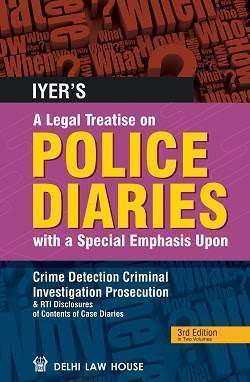
Iyer’s A Legal Treatise on POLICE DIARIES, 3rd Edition
RM675.00
– With a Special Emphasis Upon Crime Detection Criminal Investigation Prosecution
Author: Justice V. R. Krishna Iyer, R.M. Tufail & assisted by S.K.P. Sriniwas
Format: Hardback (2 Volumes)
ISBN: 9789381308400
Country: India
Published: 2022, 3rd Edition
Sold out!
| Weight | 2 kg |
|---|---|
| Dimensions | 21 × 30 × 15 cm |
Customer Reviews
There are no reviews yet.
Only logged in customers who have purchased this product may leave a review.
Related products
-

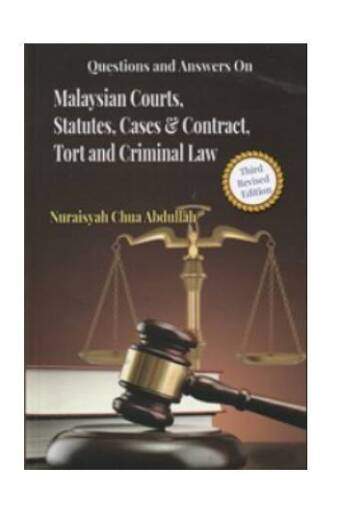
QUESTIONS AND ANSWERS ON MALAYSIAN COURTS, STATUTES, CASES & CONTRACT, TORT AND CRIMINAL LAW ( THIRD REVISED EDITION )
RM69.00This is the third revised edition of Questions & Answers on Malaysian Courts, Statutes, Cases & Contract, Tort and Criminal Law, which was first published in 2004 and revised in 2007. In this edition, a new chapter on ”The Legal Profession and Legal Aid Schemes ” has been included. The other Chapters have also been revised with new judgements being included.
This book is aimed to cater to pre-law students and the general public in providing the basic legal knowledge on the above topics. It briefly explains the judicial system, statutes i.e. the Laws of Malaysia and three other areas of law i.e. Contract, Tort and Criminal Law. The questions and suggested answers appearing in this edition have been revised as well and are prepared in line with the examination prospect.
-

LAW OF SEDITION ( IN GOOD CONDITION )
RM49.00Contents :
- MEANING, SCOPE AND HISTORY OF SEDITION
- CHANGING INTERPRETATION OF THE CONCEPT OF SEDITION AND SOME NOTABLE TRIALS
- SEDITION VIS-A-VIS THE FREEDOM OF SPEECH AND EXPRESSION
- LAW OF SEDITION IN INDIA IN THE PRESENT CONTEXT – AN ANALYSIS
- CONCLUSION AND SUGGESTIONS
- APPENDICES
-
RIGHTS OF SUSPECT AND ACCUSED UNDER ISLAMIC AND MALAYSIAN LAW
RM37.50This book analyses the Islamic viewpoint on the rights of a suspect or an accused at all stages of criminal procedures. Al-Qur’an, al-sunnah and other sources of Islamic Law have been the basis of discussion. The opinion of the four established sunni schools have also been referred to. The findings are thereafter compared with Malaysian law. It has been observed that there are more similarities than differences between the two systems of law. In some aspects where there are differences, it is hoped that the implementation of suggestions made throughout this book could harmonise the differences and at the same time refined laws could be introduced in order to maintain justice.
-
A Handbook on Juvenile Justice Third Edition Paperback
RM93.50A Handbook On Juvenile Justice Juvenile Justice (Care and Protection of Children) Act, 2000 *Definitions *Commencement and Application *Juvenile in Conflict with Law *Child in Need of Care and Protection *Rehabilitation and Social Reintegration *Miscellaneous *Fundamental Principles of Juvenile Justice and Protection of Children *Juvenile in Conflict with Law *Child in Need of Care and Protection *Rehabilitation and Social Reintegration *Standards of Care and Institutions *Miscellaneous *Sexual Offences Against Children *Using Child for Pornographic Purposes and Punishment Therefor *Abetment and Attempt to Commit and Offence *Procedure for Reporting of Cases *Procedures for Recording Statement of The Child *Special Courts *Procedure and Powers of Special Courts and Recording of Evidence *Miscellaneous *Protection of Children from Sexual Offences Rules, 2012 *Prohibition of Child Marriage Act, 2006 *The National Commission for Protection of Child Rights *Functions and Powers of The Commision *Children’s Courts *Finance, Accounts and Audit *Miscellaneous
-
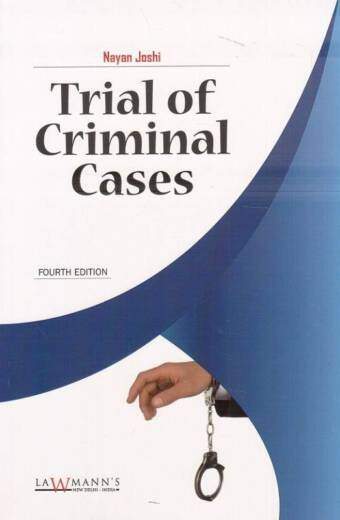
TRIAL OF CRIMINAL CASES
RM120.00* 1 COPY LEFT
“Trial” means the conclusion, by a competent tribunal of questions in issue in legal proceedings, whether civil or criminal.
In the oxford Dictionary the meaning of the word “trial” is: (1) The examination and determination of a cause by a judicial tribunal, determination of the guilt or innocence of an accused person by a Court; (2) The determination of a person’s guilt or innocence, of the right cousness of his cause, by a combat between the accuser and accused.
Generally speaking the word “trial”, is understood as referring to the stage of the proceedings in a criminal case after the charge had been framed against the accused. But sometimes the word ‘trial’ has been used in the Criminal Procedure Code itself as referring to a stage of proceedings prior to the framing of the charges.
-
P Ramanatha Aiyar: Cross Examination, Principles & Precedents
RM450.00By Justice M R Mallick
Publication Date: 2011
ISBN: 9788180386442
Format: Hardcover -
-
MAY ON CRIMINAL EVIDENCE 6TH EDITION
RM495.00Criminal evidence is an area of the law that is both highly complex and rapidly changing. All criminal practitioners must have a clear understanding of the principles and practice of the relevant rules of evidence. The sixth edition of May on Criminal Evidence provides just such an understanding. The Criminal Justice Act 2003 made enormous changes to much of the law on criminal evidence and that, combined with the extent of amending and subsequent legislation and case law, means that access to a comprehensive account and analysis of the present-day law is essential for criminal practitioners. Another development has been the growing importance of the European Convention on Human Rights and its application to the law of England and Wales. The principles of the Convention
and their analysis by the European Court of Human Rights at Strasbourg are now embedded in English law and practice and are deftly interwoven into the text of this edition. Recent developments in case law and legislation in all areas of criminal evidence are also covered.- The meaning and classification of evidence; best evidence; admissibility and relevance; real evidence; documents
- The burden and standard of proof
- Exclusionary rules and exceptions: evidence of opinion; character; hearsay including confessions.
- Exclusion through discretion; privilege; public interest; Convention rights
- Identification; corroboration; suspect evidence
- Rules connected with the trial: functions of judge, jury, justices; competence and compellability of witnesses; disclosure; course of evidence; previous consistent statements; examination of witnesses