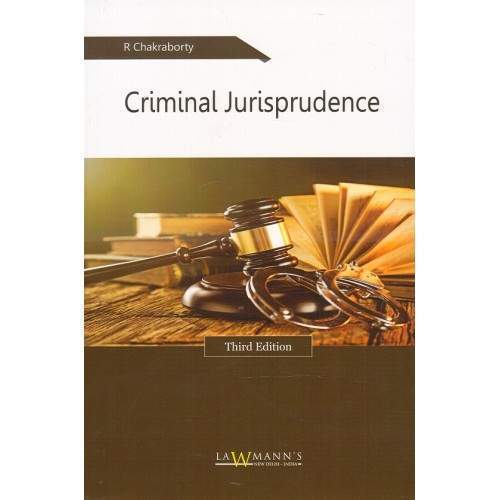
Author: R. Chakraborty
Book Code: 9789385444586
RM105.00
5 in stock
Author: R. Chakraborty
Book Code: 9789385444586
There are no reviews yet.
Only logged in customers who have purchased this product may leave a review.
Bringing you the authority, trust and reassurance you would expect from Archbold, but designed specifically for the magistrates’ court, Archbold Magistrates’ Courts Criminal Practice arms you with all the expertise you need to successfully practice in the magistrates’ court.
The works presents the information you need in an order that mirrors the progress of a case. Each offences chapter is set out in the same logical way, defining the offence with extracts from the relevant statutes; then dealing with procedure, elements of the offence, defences and sentencing.
Archbold Magistrates’ Courts Criminal Practice:
The new edition of Archbold Magistrates’ brings you completely up to date with all the latest case law and legislation. It contains the new Criminal Procedure Rules 2010 as well as the recently published Definitive Guidelines on “Overarching Principles – Sentencing Youths”, published by the Sentencing Guidelines Council.
Sexual harassment and bullying must come to an end. These behaviours are not appropriate in a civilised society. Each and every employer is responsible to stop their employees from behaving in this unacceptable manner. The aim of this book is to help employers and human resource department staff achieve this worthwhile objective. A Practical Approach to Workplace Sexual Harassment and Bullying covers a range of topics helpful to parties with an interest in this topic including: a brief background on sexual harassment and bullying in Malaysia; definitions of sexual harassment and bullying; summaries of cases heard in the Industrial Court relating to sexual harassment; carrying out an investigation into a claim by an employee that he or she has been harassed; taking disciplinary action against suspected sexual harassers or bullies; training and other interventions which can help reduce incidences of this behaviour and an examination of bullying in the Malaysian context. Changing employees’ behaviour is a difficult task but, if successful in eradicating sexual harassment and bullying, it is worth the effort.
Led by The Right Honourable Sir Anthony Hooper and David Ormerod QC (Hon), our team of authors has been hand-picked to ensure that you can trust our unique combination of authority and practicality. With a simultaneous supplement containing essential materials, you can rely on Blackstone’s Criminal Practice to be your constant companion through every courtroom appearance.
This new edition has been meticulously revised to provide extensive coverage of all new legislation, case law, and Practice Directions. With free Quarterly Updates, and monthly web updates, you can trust Blackstone’s Criminal Practice to provide reassurance on all the latest developments in criminal law and procedure.
New to this edition:-
Contents :
MAIN VOLUME;
PART A: GENERAL PRINCIPLES OF THE LAW; A1 Actus reus: the external elements of an offence A2 Mens Rea A3 General defences A4 Parties to offences A5 Inchoate offences A6 Corporate Liability A7 Human rights A8 Territorial and extra-territorial jurisdiction A9 European Union Law
PART B: OFFENCES; B1 Homicide and related offences B2 Non-fatal offences against the person B3 Sexual offences B4 Theft, handling stolen goods and related offences B5 Fraud, Blackmail and Deception B6 Falsification, forgery and counterfeiting B7 Company, commercial and insolvency offences B8 Damage to property B9 Offences affecting security B10 Terrorism, piracy and hijacking B11 Offences affecting public order B12 Offences relating to weapons B13 Offences affecting enjoyment of premises B14 Offences against the administration of justice B15 Corruption B16 Revenue customs and social security offences B17 Offences involving misuse of computers B18 Offences involving writing, speech or publication B19 Offences related to drugs B20 Offences relating to dangerous dogs, hunting and animal welfare B21 Offences relating to money laundering and the proceeds of criminal conduct B22 Immigration offences
PART C: ROAD TRAFFIC OFFENCES; C1 Definitions and basic principles in road traffic cases C2 Evidence and procedure in road traffic cases C3 Offences relating to driving triable on indictment C4 Offences relating to documents triable on indictment C5 Drink-driving offences C6 Summary traffic offences C7 Sentencing C8 The schedules 2 and 3 to the Road Traffic Offenders Act 1988
PART D: PROCEDURE;D1 Powers of investigation D2 The decision to prosecute and diversion D3 Courts, parties and abuse of process D4 Criminal procedure rules and case management D5 Preliminary procedures in magistrates’ courts D6 Classification of offences and determining mode of trial D7 Bail D8 Assets recovery D9 Disclosure D10 Sending cases from the magistrates’ court to the Crown Court D11 The indictment D12 Arraignment and pleas D13 Juries D14 Special Measures and anonymity orders D15 Trial on indictment: general matters and pre-trial procedure D16 Trial on indictment: the prosecution case D17 Trial on indictment: the defence case D18 Trial on indictment: procedure between close of defence evidence and retirement of jury D19 Trial on indictment: procedure relating to retirement of jury and verdict D20 Trial on indictment: sentencing procedure D21 Summary trial: general and preliminary matters D22 Summary trial: the course of the trial D23 Sentencing in the magistrates’ court D24 Trial of juveniles D25 Civil behaviour orders: ASBOs, Closure Orders, CPOs, and VOOs D26 Appeal to the Court of Appeal (Criminal Division) following trial on indictment D27 Procedure on appeal to the Court of Appeal (Criminal Division) D28 Reference to the Court of Appeal (Criminal Division) following trial on indictment D29 Challenging decisions of magistrates’ courts and of the Crown Court in its appellate capacity D30 Appeals to the House of Lords and the role of the European Court of Justice and the European Court of Human Rights D31 Extradition D32 Public funding D33 Costs
PART E: SENTENCING;E1 Sentencing: general provisions E2 Custodial sentences: general provisions E3 Mandatory life sentences E4 Custodial sentences for dangerous offenders under the Criminal Justice Act 2003 E5 Prescribed custodial sentences E6 Suspended sentences under the Criminal Justice Act 2003 E7 Custodial sentences: detention and custody of offenders under 21 E8 Community Order under the Criminal Justice Act 2003 E9 Youth rehabilitation orders E10 Referral order E11 Reparation orders E12 Absolute and conditional discharges E13 Binding over E14 Orders against parents E15 Fines E16 Compensation orders E17 Restitution orders E18 Deprivation and forfeiture orders E19 Confiscation orders E20 Recommendation for deportation E21 Exclusions and disqualifications E22 Mentally disordered offenders E23 Notification requirements under the Sexual Offences Act 2003 E24 Rehabilitation of offenders
PART F: EVIDENCE;F1 General principles of evidence in criminal cases F2 The discretion to exclude evidenceevidence unlawfully, improperly or unfairly obtained F3 Burden and standard of proof and presumptions F4 Competence and compellability of witnesses and oaths and affirmations F5 Corroboration and Care Warnings F6 Examination-in-chief F7 Cross-examination and re-examination F8 Documentary evidence and real evidence F9 Public policy and privilege F10 Opinion evidence F11 Admissibility of previous verdicts F12 Character evidence: evidence of bad character of accused F13 Character evidence: admissibility of evidence of accused’s good character F14 Character evidence: evidence of bad character of persons other than the accused F15 The rule against hearsay: general principles F16 Exceptions to the rule against hearsay (excluding confessions) F17 The rule against hearsay: confessions F18 Evidence of identification F19 Inferences from silence and the non-production of evidence
APPENDICES;Appendix 1 Codes of Practice under the Police and Criminal Evidence Act 1984Appendix 2 Attorney-General’s GuidelinesAppendix 3 The CPS Code for Crown ProsecutorsAppendix 4 Disclosure;
(SIMULTANEOUS) SUPPLEMENT 1;The Consolidated Criminal Practice Direction The Criminal Procedure Rules 2013 Sentencing Guidelines
![TEST YOURSELF IN [A] EVIDENCE, [B] CIVIL PROCEDURE, [C] CRIMINAL PROCEDURE, [D] SENTENCING TENTH EDITION ( IN GOOD CONDITION )](https://marsdenlawbook.com/wp-content/uploads/2020/07/test-scaled-150x229.jpg)
The multiple choice questions in this book have been designed to help law students reinforce their knowledge and understanding in the important areas of Evidence, Civil Procedure, Criminal Procedure and Sentencing.
The book is a distillation of many years’ teaching experience by senior teaching staff at the Inns of Court School of Law. The book contains 140 multiple choice questions together with note-form answers. The questions will enable students of these subjects to test with speed and accuracy their comprehension of the main principles and the leading cases. This new edition has been thoroughly updated to reflect all recent developments in the law.
Both LLB and Bar students will find this book an invaluable aid to effective revision. Not only does it cover the core subjects of Evidence, Civil Procedure, Criminal Procedure, and Sentencing, but it does so in a totally unique way.
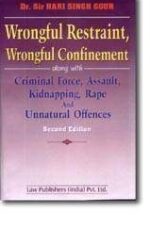
The first edition of the book “Wrongful Restraint, Wrongful Confinement, Kidnapping, Rape and Unnatural Offences” was published way back in 1973 and very soon it went out of print very soon. This itself speaks volumes about the richness of contents and significant value of the book.
Since the publication of the first edition there has been a tremendous increase in case law of the Apex Court law have been surveyed and properly allocated int he body of the book after selection under appropriate headings and subheadings so that any point can be easily traced and studied. The claim that the book has acquired for itself the unchallenged statutes of a veritable classic, can brook no contradiction. A sincere attempt has however, been made to maintain the sterling value and distinctive qualities of the original book with no paints spared and no stones unturned.
Worngful Restraint, Wrongful Confinerment, Kidnapping, Criminal Force, Assault, Rape and Unnatural Offences is a very important branch of Criminal Laws.
We hope that this edition like former one would fully cater to the needs of the legal profession, Courts and public at large on this important branch of law and prove to be not only as a useful guide but will become an indispensable book of reference for the day-to-day use the Bench and the Bar alike.
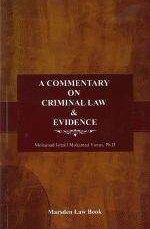
Author: Mohamad Ismail Mohamad Yunus, Ph.D
Published: 2014
Format: Paperback
ISBN: 9789839908374
Country: Malaysia
![SEDITION ACT 1948 ( ACT 15 ) [WITH NOTES ON CASES]](https://marsdenlawbook.com/wp-content/uploads/2020/08/sed-scaled-150x229.jpg)
Sedition Act 1948 ( Act 15 ) [With Notes on Cases] is another publication under the series of Practitioners’ Referencer. It carriers section-by-section notes on cases, decided by various courts, both local and foreign, including excerpts from such precedents. For the benefit of the readers, this publication also carriers parts of other laws, which are either directly or indirectly related to Sedition Act 1948. It will be extremely useful to members of the Bench and Bar, institutions of higher learning and the general public.
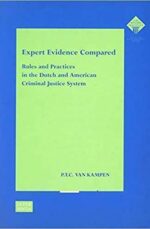
In modern criminal trials, expert evidence often plays an important role. The question as to the guilt of the defendant is often contingent upon the results of DNA analysis, polygraphs, hair comparisons, and other forensic science techniques. At the same time, through a wide variety of problems inherent to the collection and production of such evidence, the use of expert evidence in criminal litigation is often highly problematical. The vast range of problems that have been identified over the years, and the manifest presence of these problems in some of the more notorious ‘miscarriages of justice’ have made expert evidence one of the most debated topics in legal literature today. Many believe that in this particular field, criminal justice systems are in dire need of legal reform. This study attempts to contribute to this debate through an analysis and comparison of two legal systems that each employ a different method for expert involvement. The study seeks to identify the similarities and differences in how different legal systems deal with expert evidence. Additionally it seeks to establish what the experiences of one country can bring to another for the purpose of enhancing the cornerstone of criminal litigation: the concept of procedural fairness.