- Publication Date : Nov – 2020
- Author : Tan Sri James Foong & Tan Sri Zainun Ali (Consulting Editors)
- ISBN : 9789674009304
- Format : Hardcover
- Country : Malaysia
- Publication Year : Nov – 2020

Mallal’s Criminal Procedure – 8th Edition
RM650.00
Over a period of fifty-five years, Dr Bashir Mallal’s progressive editions of Mallal’s Criminal Procedure have established an enviable and respected tradition. This Eighth Edition continues Dr Mallal’s aims of providing the legal profession with an authoritative and practical guide to the criminal procedure and practice of both the Superior and Subordinate Courts in Malaysia.
Mallal’s Criminal Procedure contains detailed annotations to all the sections of the Criminal Procedure Code. These annotations, supported by relevant authorities, explain and analyse important aspects of criminal procedure as well as provide useful information such as the history of each section and similarities, if any, to the Indian Criminal Procedure Code 1973 and the Singapore Criminal Procedure Code 2010. They facilitate a better understanding of criminal procedure and serve as signposts for further research.
Other important contents of this edition include the Comparative Table and latest statutory amendments to the Criminal Procedure Code which have come into force since the previous edition was published. Mallal’s Criminal Procedure contains detailed annotations to sections 1-445 of the Criminal Procedure Code.
The annotations to each section have been organised according to the following:
- Scope (or synopsis) of section
- Cross-references to statutes, encyclopaedias and textbooks
- Amendments
- Annotations
Customer Reviews
There are no reviews yet.
Only logged in customers who have purchased this product may leave a review.
Related products
-

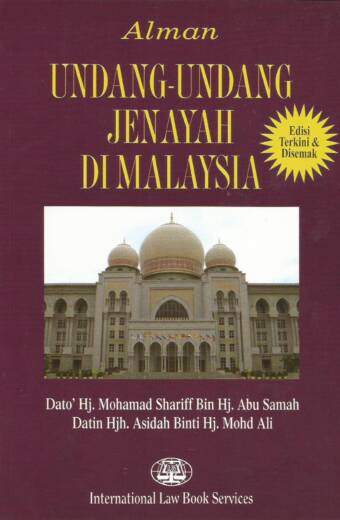
ALMAN UNDANG-UNDANG JENAYAH DI MALAYSIA
RM94.50Alman Undang-Undang Jenayah di Malaysia mengandungi topik-topik penting, terpilih dan juga popular daripada undang-undang jenayah, antaranya Konsep Liabiliti Jenayah, Kesalahan Homisid, Jenayah Bunuh, Rogol, Sumbang Mahram ( Incest ), Kesalahan Melancarkan Peperangan ke atas Yang di-Pertuan Agong dan lain-lain. Semua topik ini turut dianalisis secara kritikal dari perspektif pendakwaaan dan pembelaan. Malah, topik-topik ini dibincangkan secara komprehensif dan lengkap dengan beberapa keputusan Mahkamah Rayuan di Malaysia dan negara-negara Komanwel.
-
-

A COMMENTARY ON CRIMINAL LAW & EVIDENCE
RM120.00This book is unique in that its methodology, approach and style of presentation in which the relevant materials have been analyzed, organized and presented making it a convenient, clear, compact, concise and comprehensive source of reference.
This book will be a ready source of reference and consultation, not only for the law students but also for those involved in the teaching of criminal law and evidence. It is hoped that it will serve as a simple and useful guide for fresh practitioners. Busy judges and experienced practitioners will also find it extremely useful as it contains a rich source of reading materials and covers plethora of cases.
RM240.00 -
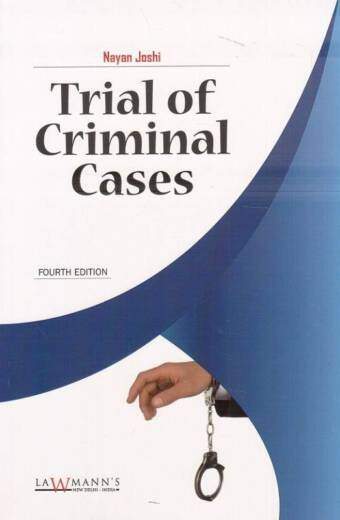
TRIAL OF CRIMINAL CASES
RM120.00* 1 COPY LEFT
“Trial” means the conclusion, by a competent tribunal of questions in issue in legal proceedings, whether civil or criminal.
In the oxford Dictionary the meaning of the word “trial” is: (1) The examination and determination of a cause by a judicial tribunal, determination of the guilt or innocence of an accused person by a Court; (2) The determination of a person’s guilt or innocence, of the right cousness of his cause, by a combat between the accuser and accused.
Generally speaking the word “trial”, is understood as referring to the stage of the proceedings in a criminal case after the charge had been framed against the accused. But sometimes the word ‘trial’ has been used in the Criminal Procedure Code itself as referring to a stage of proceedings prior to the framing of the charges.
-
FILING OF CRIMINAL CASES: PROCEDURAL ASPECTS & PRACTICE
* 5 COPIES LEFT
Personal liberty is fundamental and can be circumscribed only by some process sanctioned by law. Liberty of a citizen is undoubtedly important but this is to balance with the security of the community. A balance is required to be maintained between the personal liberty of the accused and the investigational right of the police. It must result in minimum interference with the personal liberty of the accused and the right of the police to investigate the case. It has to dovetail two conflicting demands, namely, on the one hand the requirements of the society for being shielded from the hazards of being exposed to the misadventures of a person alleged to have committed a crime; and on the other, the fundamental canon of criminal jurisprudence viz. the presumption of innocence of an accused till he is found guilty. Liberty exists in proportion to wholesome restraint, the more restraint on others to keep off from us, the more liberty we have.
-
Criminal Trial and Investigation (In two volumes)
RM900.00Criminal Trial and Investigation by P.C. Banerjee is an odyssey towards Justice and is meant for doing Justice not only to the victim but also to the society at large. Criminal Trial is a process for doing Public Justice by punishing the criminal. A judge does not preside over a Criminal Trial merely to see that no innocent man is punished but also presides to see that a guilty man does not escape. Ipso facto, both are public duties. -
BLACKSTONE’S CRIMINAL PRACTICE 2014 ( IN GOOD CONDITION )
RM450.00Led by The Right Honourable Sir Anthony Hooper and David Ormerod QC (Hon), our team of authors has been hand-picked to ensure that you can trust our unique combination of authority and practicality. With a simultaneous supplement containing essential materials, you can rely on Blackstone’s Criminal Practice to be your constant companion through every courtroom appearance.
This new edition has been meticulously revised to provide extensive coverage of all new legislation, case law, and Practice Directions. With free Quarterly Updates, and monthly web updates, you can trust Blackstone’s Criminal Practice to provide reassurance on all the latest developments in criminal law and procedure.
New to this edition:-
- Coverage of all new developments including the continuing implementation of the Legal Aid, Sentencing, and Punishment of Offenders Act,
- updated Criminal Procedure Rules and Sentencing Guidelines,
- the revised Consolidated Criminal Practice Direction,
- and the Crime and Courts Act 2013.
Contents :
MAIN VOLUME;
PART A: GENERAL PRINCIPLES OF THE LAW; A1 Actus reus: the external elements of an offence A2 Mens Rea A3 General defences A4 Parties to offences A5 Inchoate offences A6 Corporate Liability A7 Human rights A8 Territorial and extra-territorial jurisdiction A9 European Union Law
PART B: OFFENCES; B1 Homicide and related offences B2 Non-fatal offences against the person B3 Sexual offences B4 Theft, handling stolen goods and related offences B5 Fraud, Blackmail and Deception B6 Falsification, forgery and counterfeiting B7 Company, commercial and insolvency offences B8 Damage to property B9 Offences affecting security B10 Terrorism, piracy and hijacking B11 Offences affecting public order B12 Offences relating to weapons B13 Offences affecting enjoyment of premises B14 Offences against the administration of justice B15 Corruption B16 Revenue customs and social security offences B17 Offences involving misuse of computers B18 Offences involving writing, speech or publication B19 Offences related to drugs B20 Offences relating to dangerous dogs, hunting and animal welfare B21 Offences relating to money laundering and the proceeds of criminal conduct B22 Immigration offences
PART C: ROAD TRAFFIC OFFENCES; C1 Definitions and basic principles in road traffic cases C2 Evidence and procedure in road traffic cases C3 Offences relating to driving triable on indictment C4 Offences relating to documents triable on indictment C5 Drink-driving offences C6 Summary traffic offences C7 Sentencing C8 The schedules 2 and 3 to the Road Traffic Offenders Act 1988
PART D: PROCEDURE;D1 Powers of investigation D2 The decision to prosecute and diversion D3 Courts, parties and abuse of process D4 Criminal procedure rules and case management D5 Preliminary procedures in magistrates’ courts D6 Classification of offences and determining mode of trial D7 Bail D8 Assets recovery D9 Disclosure D10 Sending cases from the magistrates’ court to the Crown Court D11 The indictment D12 Arraignment and pleas D13 Juries D14 Special Measures and anonymity orders D15 Trial on indictment: general matters and pre-trial procedure D16 Trial on indictment: the prosecution case D17 Trial on indictment: the defence case D18 Trial on indictment: procedure between close of defence evidence and retirement of jury D19 Trial on indictment: procedure relating to retirement of jury and verdict D20 Trial on indictment: sentencing procedure D21 Summary trial: general and preliminary matters D22 Summary trial: the course of the trial D23 Sentencing in the magistrates’ court D24 Trial of juveniles D25 Civil behaviour orders: ASBOs, Closure Orders, CPOs, and VOOs D26 Appeal to the Court of Appeal (Criminal Division) following trial on indictment D27 Procedure on appeal to the Court of Appeal (Criminal Division) D28 Reference to the Court of Appeal (Criminal Division) following trial on indictment D29 Challenging decisions of magistrates’ courts and of the Crown Court in its appellate capacity D30 Appeals to the House of Lords and the role of the European Court of Justice and the European Court of Human Rights D31 Extradition D32 Public funding D33 Costs
PART E: SENTENCING;E1 Sentencing: general provisions E2 Custodial sentences: general provisions E3 Mandatory life sentences E4 Custodial sentences for dangerous offenders under the Criminal Justice Act 2003 E5 Prescribed custodial sentences E6 Suspended sentences under the Criminal Justice Act 2003 E7 Custodial sentences: detention and custody of offenders under 21 E8 Community Order under the Criminal Justice Act 2003 E9 Youth rehabilitation orders E10 Referral order E11 Reparation orders E12 Absolute and conditional discharges E13 Binding over E14 Orders against parents E15 Fines E16 Compensation orders E17 Restitution orders E18 Deprivation and forfeiture orders E19 Confiscation orders E20 Recommendation for deportation E21 Exclusions and disqualifications E22 Mentally disordered offenders E23 Notification requirements under the Sexual Offences Act 2003 E24 Rehabilitation of offenders
PART F: EVIDENCE;F1 General principles of evidence in criminal cases F2 The discretion to exclude evidenceevidence unlawfully, improperly or unfairly obtained F3 Burden and standard of proof and presumptions F4 Competence and compellability of witnesses and oaths and affirmations F5 Corroboration and Care Warnings F6 Examination-in-chief F7 Cross-examination and re-examination F8 Documentary evidence and real evidence F9 Public policy and privilege F10 Opinion evidence F11 Admissibility of previous verdicts F12 Character evidence: evidence of bad character of accused F13 Character evidence: admissibility of evidence of accused’s good character F14 Character evidence: evidence of bad character of persons other than the accused F15 The rule against hearsay: general principles F16 Exceptions to the rule against hearsay (excluding confessions) F17 The rule against hearsay: confessions F18 Evidence of identification F19 Inferences from silence and the non-production of evidence
APPENDICES;Appendix 1 Codes of Practice under the Police and Criminal Evidence Act 1984Appendix 2 Attorney-General’s GuidelinesAppendix 3 The CPS Code for Crown ProsecutorsAppendix 4 Disclosure;
(SIMULTANEOUS) SUPPLEMENT 1;The Consolidated Criminal Practice Direction The Criminal Procedure Rules 2013 Sentencing Guidelines -
LAW OF NARCO-ANALYSIS RIGHT AGAINST SELF-INCRIMINATION
RM64.90Narco-analysis test is based on the principle that a person is able to lie using his imagination and in narco-analysis this capacity for imagination blocked or neutralized by leading him into semiconscious state and in this stage it becomes difficult for the person to lie and his answers would be restricted to facts he is already aware of.