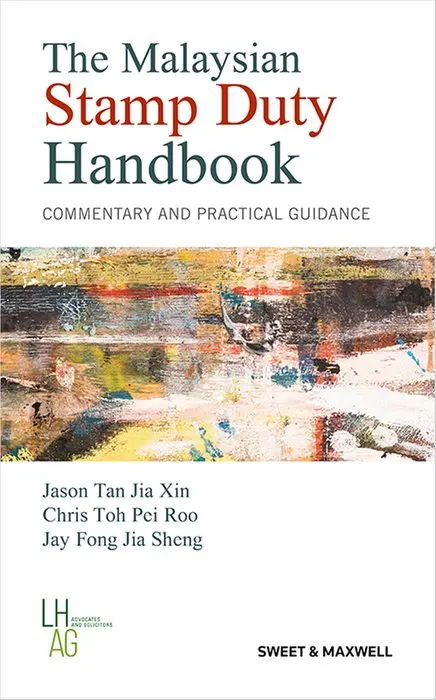
Stamp duty law in Malaysia is entering a complex new phase. With the phased implementation of the self-assessment system from January 1, 2026, and the Inland Revenue Board’s Stamp Duty Audit Framework, taxpayers can no longer rely on official adjudication by the Stamp Office. The onus to determine, report and pay the correct stamp duty now rests solely on taxpayers, bringing heightened compliance risks, audit exposure and potential penalties.
Against this background, the Malaysian Stamp Duty Handbook offers a timely, authoritative, and highly practical guide to navigating the evolving stamp duty landscape under the Stamp Act 1949 and related subsidiary legislation. The book addresses persistent misconceptions – such as whether documents need stamping only for court purposes or whether intercompany agreements are exempt – while equipping readers with the knowledge required for modern compliance.
Drawing on the authors’ close engagement with stamp duty practice, the book combines technical accuracy with practical insight, making complex rules accessible. It guides readers through the full compliance lifecycle – from execution and stamping to audits, enforcement and appeals – ensuring a comprehensive understanding of obligations and risks. Designed for accountants, lawyers, tax advisers, company secretaries, finance professionals and business owners, this handbook is an indispensable resource for anyone involved in transactions where instruments may attract stamp duty.
In an era where incorrect stamping could result in reassessments years later, the Malaysian Stamp Duty Handbook provides the clarity, confidence and compliance strategies needed to navigate Malaysia’s new regulatory environment successfully.
Key features:
-
- The transition from adjudication to self-assessment and its legal implications.
- The Stamp Duty Audit Framework, audit triggers and voluntary disclosure opportunities.
- Classification of chargeable instruments, computation of duty and available reliefs.
- Penalties, enforcement powers and best judgment assessments by the Collector.
- Risk management strategies, internal compliance reviews and documentation practices.
- Objections, appeals and dispute resolution procedures.
- Judicial principles governing the interpretation of taxing statutes.
Table of Contents:
1. General overview and principles of stamp duty
2. Execution, territory and timing
3. Stamping under the self-assessment system
4. Reliefs
5. Stamp duty audits
6. Best judgment assessments
7. Enforcement power of the Collector
8. Stamp duty penalties
9. Chargeable instruments
10. General exemptions
11. Appeals
About the Authors:
Jason Tan Jia Xin heads the Tax, Customs & Trade Practice at Lee Hishammuddin Allen & Gledhill. His practice encompasses advisory and litigation work related to income tax, customs, stamp duty, as well as trade remedy investigations, tax audits and regulatory compliance. He has represented taxpayers in some of Malaysia’s largest tax and customs disputes at all court levels. Jason regularly advises multinational corporations, financial institutions, government-linked companies and is recognised by Legal 500 Asia-Pacific, Chambers Asia-Pacific and ITR World Tax 2025 for his tax practice.
Chris Toh Pei Roo is a partner of Lee Hishammuddin Allen & Gledhill and a member of the firm’s Tax, Customs & Trade Practice and Succession, Trusts, Estate Planning & Private Wealth Practice. He advises and represents taxpayers on a wide range of tax issues, with particular expertise in tax disputes, judicial review and challenges against decisions of the Inland Revenue Board, Royal Malaysian Customs and the Ministry of Finance. Chris has acted for multinational corporations, listed companies, high-net-worth individuals and is a regular speaker and examiner in revenue law for the hartered Tax Institute of Malaysia. He holds a first-class LLB from the University of Leeds and an LLM from University College, London.
Jay Fong Jia Sheng is a senior associate in the Tax, Customs & Trade Practice at Lee Hishammuddin Allen & Gledhill. He advises on a wide range of tax matters, including income tax, stamp duty, transfer pricing, real property gains tax and sales and services tax, with experience in tax controversy, advisory, compliance and risk management. Jay represents clients at all levels of the Malaysian courts and has been involved in several high-profile tax disputes. He advises multinational corporations, financial institutions, government-linked companies and SMEs, and holds a first-class LLB from the University of Liverpool