This work will ensure that practitioners and insurers have all the information and guidance they need to assess the risk of a case in a practical and effective way and learn to develop strategies to identify and manage risk in litigation. It covers the law and principles of conditional fee agreements as well as considering the insurance and funding aspects.

Risk Assessment in Litigation: Conditional Fee Agreements, Insurance & Funding
RM490.00
Author: David Chalk Principal Lecturer, Anglia Polytechnic University
Published in: June 2001
ISBN: 9781845927523
Format: Hardback
Country of Publication: UK
Customer Reviews
There are no reviews yet.
Only logged in customers who have purchased this product may leave a review.
Related products
-

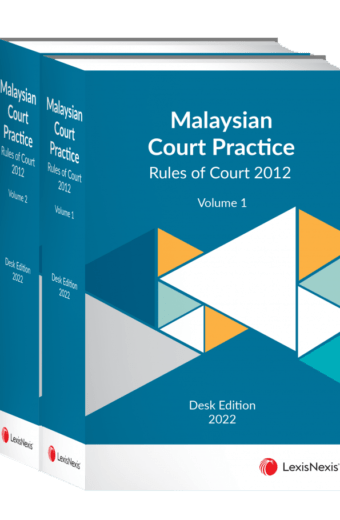
Malaysian Court Practice, Rules of Court 2012, Desk Edition 2022
RM585.00Mastery of civil procedure is the cornerstone to a good litigation practice. Malaysian Court Practice, Rules of Court 2012, Desk Edition 2022 is a solid, comprehensive & up-to-date starting point for any practitioner who wishes to maneuver the labyrinth of Malaysian civil procedure law. This book embodies a detailed provision-by-provision annotation on the latest development of the law – both legislative and judicial pronouncements up to a cut-off date of March 2022. The updates include annotated analysis on the large number of cases that have dealt with the various provisions under the Rules of Court over the preceding 4 years.
Table of contents
Volume 1
 Table of Cases
 Table of Legislation
 Table of Subsidiary Legislation
 Table of Foreign Legislation
 Table of treaties, Conventions, etc
 Annotations of Orders 1-49

 Volume 2
 Annotations of Orders 50-94
 Index
RM650.00 -
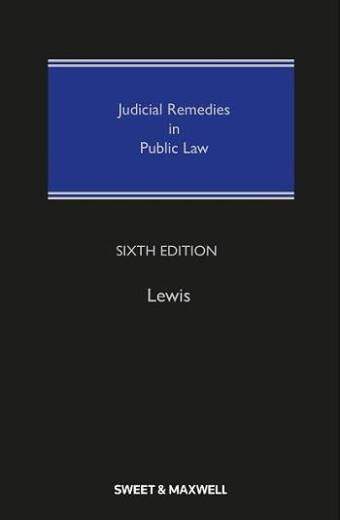
Judicial Remedies in Public Law, 6th Edition
RM1,610.00Author: Clive Lewis
ISBN13: 9780414078338
Published: December 2020
Country of Publication: UK
Format: HardbackRM1,696.00 -

Spencer Bower: Reliance-Based Estoppel
RM1,425.00Spencer Bower: Reliance-Based Estoppel, previously titled Estoppel by Representation, is the highly regarded and long established textbook on the doctrines of reliance-based estoppel, by which a party is prevented from changing his position if he has induced another to rely on it such that the other will suffer by that change.
Since the fourth edition in 2003 the House of Lords has decided two proprietary estoppel cases, Cobbe v Yeoman’s Row Property Management Ltd and Thorner v Major, whose combined effect is identified as helping to define a criterion for a reliance-based estoppel founded on a representation, namely that the party estopped actually intends the estoppel raiser to act in reliance on the representation, or is reasonably understood to intend him so to act. Other developments in the doctrine of proprietary estoppel have required a complete revision of the related chapter, Chapter 12, in this edition.
Thorner v Major confirms too the submission in the fourth edition that unequivocality is a requirement for any reliance-based estoppel founded on a representation. Other views expressed in the fourth edition are also noted to have been upheld, such as the recognition that an estoppel may be founded on a representation of law (Briggs v Gleeds), that a party may preclude itself from denying a proposition by contract as well as another’s reliance (Peekay Intermark Ltd v Australia and New Zealand Banking Group Ltd and Springwell Navigation Corp v JP Morgan Chase Bank) and that an estoppel by deed binds by agreement or declaration under seal rather than by reason of reliance (Prime Sight Ltd v Lavarello).
With the adjustment reflected in the change of title, and distinguishing the foundation of estoppels that bind by deed and by contract, the editors adopt Spencer Bower’s unificatory project by the identification of the reliance-based estoppels as aspects of a single principle preventing a change of position that would be unfair by reason of responsibility for prejudicial reliance. From this follow the views: that reliance-based estoppels have common requirements of responsibility, causation and prejudice; that estoppel by representation of fact is, like the other reliance-based estoppels, a rule of law; that the result of estoppel by representation of fact may, accordingly, be mitigated on equitable grounds to avoid injustice; that the result of an estoppel by convention depends on whether its subject matter is factual, promissory or proprietary; that a reliance-based estoppel (other than a proprietary estoppel, which uniquely generates a cause of action) may be deployed to complete a cause of action where, absent the estoppel, a cause of action would not lie, unless it would unacceptably subvert a rule of law (in particular the doctrine of consideration); that an estoppel as to a right in or over property generates a discretionary remedy; and that the prohibition on the deployment of a promissory estoppel as a sword should be understood as an application of the defence of illegality, viz that an estoppel may not unacceptably subvert a statute or rule of law.
Table Of Contents
Part I General Principles
Chapter 1 Introduction: definition and treatment
Chapter 2 Representations of fact; promises; representations of law; representations as to rights
Chapter 3 Responsibility
Chapter 4 Unequivocality and construction
Chapter 5 Inducement and reliance; the effect of estoppel as to a fact
Chapter 6 Parties to the estoppel
Chapter 7 The defence of illegality
Chapter 8 Estoppel by convention; estoppel by contract; estoppel by deed; estoppel as to title
Part II Particular Applications of Reliance-Based Estoppel
Chapter 9 Applications of reliance-based estoppel to various relationships
Chapter 10 Miscellaneous estoppels
Chapter 11 Statutory estoppel
Part III Proprietary Estoppel, Election, Promissory Estoppel and Procedure
Chapter 12 Proprietary estoppel
Chapter 13 Election
Chapter 14 Promissory estoppel
Chapter 15 Stating the caseRM1,500.00 -
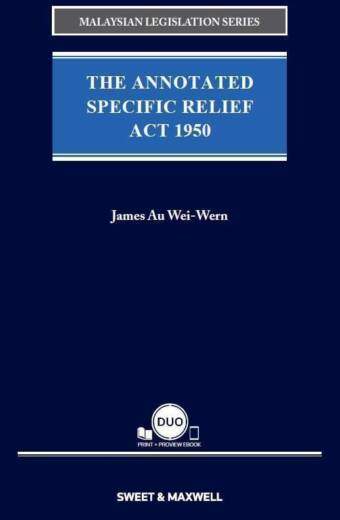
The Annotated Specific Relief Act 1950
RM120.00The Annotated Specific Relief Act 1950 provides invaluable section-by-section annotations to the Specific Relief Act 1950, throwing light on the application and interpretation of the provisions of the Act. It is written by a legal practitioner with broad experience encompassing litigation, brand enforcement and corporate advisory in Malaysia. The full text of the Act accompanies the high-quality annotations which are insightful, practical and authoritative, enabling a confident understanding of the workings of the Act.
The key terms and phrases in each section are explained by reference to local and foreign case law as well as academic writing. This publication facilitates quick and easy research with the inclusion of cross-reference from the provision being annotated to related provisions which work together with it. The annotations should prove to be very useful for lawyers, judges, court officers and law students.
KEY FEATURES:
Section-by-section commentary to the Act written in simple and straightforward style
Commentary supported by copious citation of case authorities
All defined terms are identified with direct cross-references to the provision where each definition is found
Clear page guides assist the user to locate a specific provision or Part of the Act quickly and efficiently
Supplemented by detailed index for easy access to the annotations. -
Foskett on Compromise, 10th Edition
RM2,125.00ISBN13: 9780414120730To be Published: September 2024Country of Publication: UKFormat: HardbackRM2,360.00 -
Civil Costs, 6th Edition
RM1,579.00Author: Peter Hurst
ISBN13: 9780414069169
Published: June 2018
Country of Publication: UK
Format: HardbackRM1,759.00 -
Limitation Periods, 9th edition with 1st Supplement
RM2,290.00ISBN13: 9780414122987Published: July 2024Country of Publication: UKFormat: Hardback + SupplementRM2,413.00 -
THE LAW OF COSTS IN CIVIL PROCEEDINGS, 2ND EDITION
RM575.00The determination of costs is an important matter for both the lawyer and the client. The Law of Costs in Civil Proceedings is the only book in Malaysia to comprehensively consider this subject in detail. It is written by an experienced court lawyer who is also a prolific writer. Clear analysis of the law provides great value in the book. There are also regular references to relevant statutory provisions and copious citations of cases from various jurisdictions, including Malaysia, England, Singapore and Australia. The wealth of information available will undoubtedly make this book one not to be missed.
NEW IN THIS EDITION:
- Updated to cover the provisions of the Rules of Court 2012
- Considers new casses which discuss the application of the new court rules
- Discusses the new bases of assessment introduced by the Rules of Court 2012
- Provides guidance from cases on the exercise of judge’s discretion in awarding costs
- Extensive reference to cases from Singapore, the UK and Australia which have introduced similar changes in court rules
- New chapter on costs for proceedings before the Special Commissioners of Income Tax