- Author : Jawiah Dakir
- ISBN : 9789678919487
DASAR DAN KAEDAH PEMBENTUKAN MASYARAKAT ISLAM MENURUT PERSPEKTIF AL-SUNNAH
RM45.00
Customer Reviews
There are no reviews yet.
Only logged in customers who have purchased this product may leave a review.
Related products
-

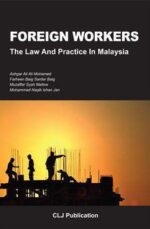
FOREIGN WORKERS THE LAW AND PRACTICE IN MALAYSIA
RM180.00This book contains information for the recruitment of foreign workers and the rights of these workers in Malaysia. International instruments and domestic legislations have been discussed at length to highlight the rights and protection accorded to these workers. The Islamic approach on this subject has also been featured in this book.
The book is intended to generate awareness on the humane treatment towards foreign workers and the consequence of their exploitation, human trafficking and smuggling of migrants among others.
-

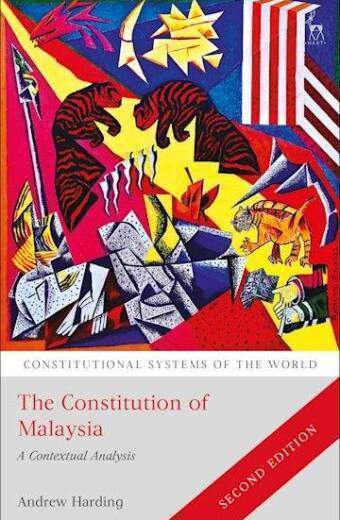
The Constitution Of Malaysia by Andrew Harding
RM175.00“This book should find its place in every person’s library…[it is] a resource for engagement and vital critical discourse.” Philip T. N. Koh, Star2
This is a welcome update to the definitive introduction to Malaysia’s constitution written by the subject’s foremost authority. Maintaining its all-encompassing perspective, it looks at constitutional governance in the context of authoritarianism and ongoing intercommunal conflict, as well as the effects of colonisation on Malaysia’s legal system.
It preserves its socio-political orientation while being completely updated to reflect all statute and case law developments. A fundamental text for all researchers and students of Malaysian law.
TABLE OF CONTENTS OF THE CONSTITUTION OF MALAYSIA, 2ND EDITION
1. Historical Background
I. Symbolic Malacca
II. The Constitution of Malacca and the Malay Concept of Monarchy
III. The Colonial Constitutional Experience: The Residential System
IV. Federalisation
V. The Malayan Union
VI. The Federation of Malaya
VII. The Reid Commission
VIII. The Commission’s Report and the Constitutional Debates
IX. The Creation of Malaysia
X. Conclusion
Further Reading2. Executive Power and the Configuration of the State
I. Introduction
II. Constitutional Structure of the Executive Power
A. Constitutional Monarchy
B. The Prime Minister
C. The Cabinet
D. Administrative Agencies and the Public Service
III. Privatisation and the Public–Private Interface
A. Privatisation and Development
B. Government-linked Companies, the State and the Public–Private Interface
IV. Conclusion
Further Reading3. The Social Contract
I. Explanation of the Concept and its Origins
II. The May 13 Incident and the ‘Rukunegara‘ Amendments
III. The Social Contract: Implementation and Critiques
Further Reading4. Parliamentary Democracy in a Plural Society
I. Introduction
II. Elections and the Composition of the Dewan Rakyat
III. Political Parties and the Political Process
IV. Parliamentary Process
V. Parliamentary Accountability
VI. Parliamentary Committees
VII. The Dewan Negara
VIII. Legislation and Emergency Powers
IX. Conclusion
Further Reading5. Territorial Governance: Monarchy and the State Constitutions
I. Introduction
II. The Powers and Position of the Rulers
III. State Government Formation and the Limits of Royal Powers
IV. The Conference of Rulers
V. Conclusion
Further Reading6. Territorial Governance: Federal, State and Local Government
I. Introduction
II. Federal and State Powers: A Measure of Autonomy
III. Federal and State Finance
IV. Asymmetry and the Special Position of Sabah and Sarawak
V. Local Government
VI. Conclusion
Further Reading7. Human Rights: A Struggle over Ambiguity
I. Introduction
II. Attitudes Towards Human Rights
III. Origins of Constitutional Rights
IV. Individual Liberty and Preventive Detention
V. Suhakam: The Human Rights Commission
VI. Human Rights: The Indigenous Perspective
VII. Conclusion
Further Reading
8. The Judiciary and the Defence of Judicial Power
I. Introduction
II. Judicial Independence and the Constitution
III. The Judicial Power
IV. Constitutional Interpretation
V. The Judicial Crisis of 1988
A. Judicial Activism 1986–88
B. The UMNO Election Case
C. A Perfect Storm: The Judiciary Entangled
D. The Bar Responds
VI. Judicial Independence: A Downward Slide
VII. A Scandal Leads to Better Outcomes: The Lawyers’ Walk for Justice
VIII. Conclusion
Further Reading9. Religion and the Constitution
I. Introduction
II. Law and Religion: History and Context
III. Islamicisation and the Islamic State
IV. Islam as the Official Religion
V. Religious Freedom
VI. Conversion and the Courts
VII. Conclusion
Further ReadingConclusion
-
The Wealth Manager’s Guide to Islamic & Conventional (Wealth Management)
RM225.00A Comparative Analysis between Islamic & Conventional Practices In Malaysia | With Legislations & Commentaries.
Author: Dato’ R. K. Nandy
ISBN: 9789671756324
Published: Oct 2023
Published by: Marsden Law Book Sdn. Bhd.RM250.00 -
The legal methods in Islamic administration
RM69.90The Legal Methods in Islamic Administration is considered as a revolution in the field of Islamic jurisprudence because the judge cannot decide in cases, according to the majority of Muslim scholars, except by the witnesses or the oath. But Ibn Al-Quayyim, a distinguished scholar and jurist of the 8th century, the author of this book explains that the judge in Islamic Law can decide in cases by more than twenty ways, all of which are based on the Holy Qur’an and the Sunnah, hence this work has been considered as a revolution.
This is a scholarly and monumental treatise on Islamic law. It reflects the idea of realizing the principles of shari’ah, particularly in the field of evidence and its application to contemporary issues.
-
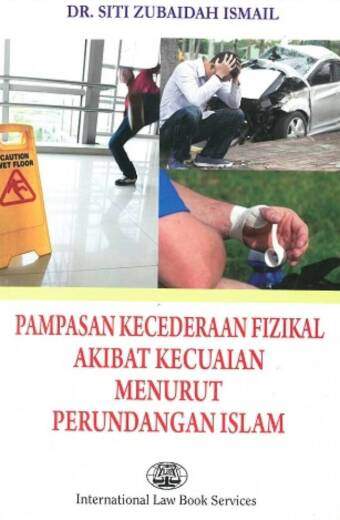
PAMPASAN KECEDERAAN FIZIKAL AKIBAT KECUAIAN MENURUT PERUNDANGAN ISLAM
RM47.50Buku ini membincangkan prinsip-prinsip tentang kecuaian dan implikasinya terhadap pelaku dalam konteks penentuan tanggungan dan pembayaran pampasan yang boleh dikenakan menurut perundangan Islam. Tiga aspek utama dibincangkan iaitu kecuaian perubatan, kemalangan jalan raya dan kecuaian pekerja. Dari situ, perbincangan dikhususkan kepada prinsip diyat (pampasan kewangan) serta bentuk dan kuantum pampasan yang bersesuaian dengan kematian, kecederaan dan kerugian yang dialami menurut perundangan Islam. Pihak-pihak yang boleh dipertanggungjawabkan juga dibincangkan, di mana prinsip “aqilah” diperjelaskan dan diberikan pentafsiran baru membabitkan syarikat insuran, badan profesional, majikan dan kerajaan selaku pihak-pihak yang turut menanggung liabiliti akibat kecuaian seseorang.
-
STUDIES IN THE ISLAMIC LAW OF CONTRACTS : THE PROHIBITION OF GHARAR
RM99.00This book focuses on the discussion of Islamic prohibition of gharar which is said to be one of the three elements that makes Islamic contracts abhor modern transactions. The other two are riba and extra stipulations in contracts. In elaborating the above concept, the book explains in brief but lucid current development of Islamic contracts in the middle eastern countries and general outlines of Islamic contracts both from the classical and modern perspectives.
-
Islamic family law : a comparative study with other religions
RM62.50Islamic Family Law- A Comparative Study With Other Religions, is a highly rated professional work on Islamic Family Law. It reflects the wide knowledge of the author on Islam and many other religions. He holds a Ph.D. in Islamic Jurisprudence from Shari’ah College, al-Azhar University,Cairo, Egypt and an L.L.B. in Public Law from the School of Law and Diplomacy, Baghdad, Iraq.
In this book, he compares Islamic Family Law with Christianity, Judaism, Roman, French, Malaysian and all Arab laws.
-
PROTECTION AND ADOPTION OF ABANDONED CHILDREN IN MALAYSIA ( A COMPARATIVE OVERVIEW WITH ISLAMIC LAW )
RM45.00In view of the pathetic and rising state of affairs in Malaysia, the author Dr. Azizah Mohd has written this book, Protection and Adoption of Abandoned Children in Malaysia – A Comparative Overview with Islamic Law, wherein she explores and discusses various principles and rules governing the protection and adoption of abandoned children in Malaysia. It highlights the rules applicable under the Malaysian law compared with the legal principles governing ”foundling” ( taqit ) in Islamic Law. The terms ”abandoned child” and ”foundling” are synonymous. Some of the aspects related to abandoned children, such as rights to custody, guardianship, maintenance, freedom, religious status, parentage, inheritance, distribution of property, and many others are discussed in this publication.