This Second Edition of the Conditions of Contract for EPC/Turnkey Projects has been published by the Fédération Internationale des Ingénieurs-Conseils (FIDIC) as an update of the FIDIC 1999 Conditions of Contract for EPC/Turnkey Projects (Silver Book), First Edition. Along with the FIDIC 1999 Red Book (the Conditions of Contract for Construction) and the FIDIC 1999 Yellow Book (the Conditions of Contract for Plant and Design-Build), the FIDIC 1999 Silver Book has been in widespread use for nearly two decades. These Conditions of Contract for EPC/Turnkey Projects are not suitable for use in the following circumstances: – If there is insufficient time or information for tenderers to scrutinise and check the Employer’s Requirements or for them to carry out their designs, risk assessment studies and estimating; – If construction will involve substantial work underground or work in other areas which tenderers cannot inspect, unless special provisions are provided to account for unforeseen conditions or – If the Employer intends to supervise closely or control the Contractor’s work, or to review most of the construction drawings. FIDIC recommends that the Second Edition of the FIDIC Yellow Book (Conditions of Contract for Plant and Design-Build) be used in the above circumstances for Works designed by (or on behalf of) the Contractor. This Second Edition of the FIDIC Silver Book maintains the principles of risk sharing established in the 1999 edition, while seeking to build on the substantial experience gained from its use over the past 18 years. For example, this edition provides: 1) greater detail and clarity on the requirements for notices and other communications; 2) provisions to address Employers’ and Contractors’ claims treated equally and separated from disputes; 3) mechanisms for dispute avoidance and 4) detailed provisions for quality management, and verification of Contractor’s contractual compliance. These Conditions of Contract for EPC/Turnkey Projects include conditions, which are likely to apply to the majority of such contracts. Essential items of information which are particular to each individual contract are to be included in the Particular Conditions Part A – Contract Data. In addition it is recognised that many Employers, especially governmental agencies, may require special conditions of contract, or particular procedures, which differ from those included in the General Conditions. These should be included in Part B – Special Provisions. It should be noted, that the General Conditions and the Particular Conditions (Part A – Contract Data and Part B – Special Provisions) are all part of the Conditions of Contract. To assist Employers in preparing tender documents and in drafting Particular Conditions of Contract for specific contracts, this publication includes Notes on the Preparation of Tender Documents and Notes on the Preparation of Special Provisions, which provide important advice to drafters of contract documents, in particular the Employer’s Requirements and Special Provisions. In drafting Special Provisions, if clauses in the General Conditions are to be replaced or supplemented and before incorporating any example wording, Employers are urged to seek legal and engineering advice in an effort to avoid ambiguity and to ensure completeness and consistency with the other provisions of the contract. This publication begins with a series of comprehensive flow charts which typically show, in visual form, the sequences of activities which characterise the FIDIC EPC/Turnkey form of contract. The charts are illustrative, however, and must not be taken into consideration in the interpretation of the Conditions of Contract. This publication also includes a number of sample forms to help both Parties to develop a common understanding of what is required by third parties such as providers of securities and guarantees. Drafters of contract documents are reminded that the General Conditions of all FIDIC contracts are protected by copyright and trademark and may not be changed without specific written consent, usually in the form of a licence to amend, from FIDIC. If drafters wish to amend the provisions found in the General Conditions, the place for doing this is in the Particular Conditions Part B – Special Provisions, as mentioned above, and not by making changes in the General Conditions as published. FIDIC considers the official and authentic texts to be the versions in the English language.

FIDIC: Conditions of Contract for EPC/turnkey Projects, 2nd Edition
RM262.00
ISBN: 9782884320832
Year of Publication: 2017
Sold out!
Customer Reviews
There are no reviews yet.
Only logged in customers who have purchased this product may leave a review.
Related products
-

Extra-Contractual Recoveries for Construction & Engineering Work (2 Vols)
RM1,345.00- Publication Date: May – 2022
- Author: Robert Fenwick Elliott
- ISBN: 9781913019570
- Format: Hardcover
- Country: U.K
-
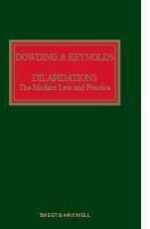
Dilapidations: The Modern Law and Practice
RM1,555.60This book is a leading authority in its field, providing comprehensive coverage of the legal principles relating to dilapidations, both residential and commercial, together with all the practical aspects pertaining to dilapidations claims. It offers a comprehensive, one-stop reference, assisting the reader with dilapidations issues and in determining of the best course of action. It discusses the legal principles clearly and accompanies this with worked examples showing how they apply in practice. It also includes precedents, forms, statutes and extensive case referencing. This book is now largely recognised by the courts and the professions as the leading work on dilapidations, and it is referred to, and quoted from, in many cases.
Key features:
- The text explores the obligations of landlord and tenant with regard to the state and repair of property
- Looks at repairing obligations, all types of repairing covenant, liability, considerations affecting the performance of obligations, liability, remedies, fees
- Explores alternative ways of resolving claims such as arbitration and proposals for reform this area of law
- It considers the rules in relation to both landlord and tenant and both commercial and residential property
- Offers a comprehensive and authoritative discussion of legal principles relating to dilapidations with examples as to how those principles might apply in practice using relevant case law
- Commentary is supported by relevant forms and precedents in the appendices
- The renowned author team offer a practical five-question approach to analysing the basic repairing covenants
New to this edition:
- A number of chapters have been substantially re-written, to reflect both further developments in the relevant law and practice, and the development of our own thinking
- Two new chapters have been added, one dealing with consequential losses (including loss of rent), and the other with contractual payment provisions. The former seemed to be of sufficient importance to merit its own separate chapter, whilst the latter deals with provisions which are becoming more common in leases
- The impact of the Minimum Energy Efficiency Standards, which are due to start affecting lettings on 1st April 2018, to consider
- Consideration of the impact of the Energy Act 2011, the 7th edition of the RICS Guidance Note “Dilapidations in England and Wales” (which came into effect on 1st September 2016) and the new Pre-action Protocol for Housing Disrepair Cases, which came into force on 6th April 2015
Recent cases referred to in this edition:
- Courtwell Properties Ltd v Greencore PF (UK) Ltd [2014] EWHC 184 (TCC)
- Sunlife Europe Properties Ltd v Tiger Aspect Holdings Ltd [2014] 1 E.G.L.R. 30
- South Essex Partnership University NHS Foundation Trust v Laindon Holdings Ltd [2016] EWCA Civ 377
- Edwards v Kumarasamy [2016] UKSC 40; [2016] 3 WLR 310
- Moorjani v Durban Estates Ltd [2016] 1 WLR 2265
- Creative Foundation v Dreamland Leisure Ltd [2016] Ch 253
- Consortium Commercial Developments Ltd v ABB Ltd [2015] EWHC 2128 (TCC)
- Uddin v Islington [2015] HLR 28
- Stratton v Patel [2014] EWHC 2677 (TCC)
- Mussellwhite v Youssefi [2014] EWCA Civ 885; [2014] 2 P & CR 14
- L Batley Pet Products Ltd v North Lanarkshire Council [2014] UKSC 27; [2014] 3 All ER 64
- Peel Land and Property (Ports No. 3) Ltd v Sheerness Steel Ltd [2014] EWCA Civ 100; [2014] 2 P&CR 8
- Reference will also be made to cases decided in Scotland, among them, Trustees for the Bridge Street Partnership v William Hill (Scotland) Ltd([2013] SLT (Sh Ct) 62 and PDPF GP Ltd v Santander UK Plc [2015] CSOH 40), and in the Commonwealth
-

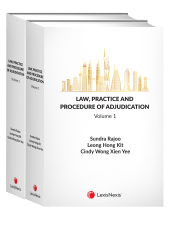
Law, Practice and Procedure of Adjudication, 2 Volumes
RM585.00ISBN/ISSN: 9789672701767
Country: Malaysia
Author: Datuk Professor Sundra Rajoo (Author), Leong Hong Kit (Author), Cindy Wong Xien YeeRM650.00 -
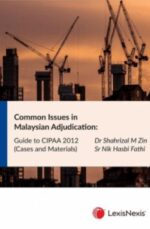
Common Issues in Malaysian Adjudication: Guide to CIPAA 2012
RM288.00This book provides a straightforward approach to the statutory adjudication process under the Construction Industry Payment and Adjudication Act 2012 (Act 746) (CIPAA 2012). The book guides the reader through the process of adjudication pursuant to CIPAA 2012 from its initiation to beyond the delivery of the adjudication decision. In this book, nearly 100 common issues have been identified that commonly crop up during various stages of the adjudication process.
This title focuses on a growing body of domestic cases, providing a clear exposition and discussion of the relevant case law. Utilising a problem-based approach, the Q&A format of the book provides answers to the common issues in Malaysian adjudication. Preceded by an introductory section, the reader is also provided with an overview of the construction process and the disputes that may arise, taking the reader from inception of construction work right to completion of a project.
Guides the reader through the adjudication process under CIPAA 2012 from start to finish
Views the construction process from start to finish with the disputes identified along the way
Identifies nearly 100 common issues that are of relevant during each stage of the adjudication process
Provides answers to the common issues in Malaysian adjudication
Covers a growing body of domestic cases while reference is made to English cases in other jurisdictions
Q and A format that is reader friendly where busy practitioners and students can quickly find the relevant section to their problemsTable of Contents
Chapter 1: An Introduction to Statutory Adjudication
Chapter 2: Before the Referral
Chapter 3: Referral to Adjudication
Chapter 4: The Process After the Referral
Chapter 5: The Conduct of The Proceedings
Chapter 6: The Adjudication Decision
Chapter 7: After Adjudication Is Over
Chapter 8: Other Considerations
RM320.00 -
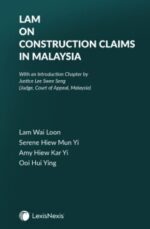
Lam on Construction Claims in Malaysia
RM360.00Publication Date: Nov – 2022
Author: Amy Hiew Kar Yi, Lam Wai Loon, Serene Hiew & Ooi Hui Ying
ISBN: 9789672701682
Format: Hardcover
Country: MalaysiaRM400.00 -
HOUSING DEVELOPMENT LAW
RM340.00This book serves as a standard text for conveyancing lawyers and others involved in the housing industry. It analyses the laws concerning the housing industry, focusing on significant issues affecting the business of housing development such as the standard form sale and purchase agreement, housing loans, delivery of vacant possession, defect liability period, sale of housing accommodations to foreign purchasers, the meaning of “housing development”, the licensing of housing development business and the opening and proper operation of housing development accounts.
The scope and extent of the main legislation, the Housing Development (Control and Licensing) Act 1966, as well as subordinate rules and regulations, are clearly explained with reference to relevant cases and comparisons to legislation from Sabah and Sarawak.This book will be an essential reference for housing developers, conveyancing practitioners, banks, regulators, and purchasers who wish to understand or to further enhance their knowledge of housing, conveyancing and property law. -
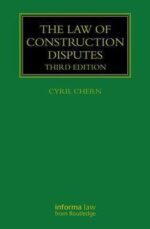
The Law of Construction Disputes, 3rd Edition
RM2,100.00Now in a fully updated third edition, The Law of Construction Disputes is a leading source of authoritative and detailed information on the whole area of construction law including contracts and their performance, third parties, pursuing claims and dispute resolution. It covers the construction dispute process by analysing the main areas from which disputes arise, up to date case law, and how to effectively deal with construction project disputes once they have arisen. Now including references to the new FIDIC contracts, which were released in 2017, this edition expands on advanced practitioner issues, as well as the emerging law of construction disputes on an international basis and gives the practitioner all the case law needed in one concise volume.
The book examines the methods and methodology of construction law, not only for a common law context, but also under other legal systems. Readers will be guided through the various international contract formats governing construction, alongside applicable case law. Additionally, they will be shown the correct contract provisions and forms used to prevent disputes from escalating in order to reach successful conclusions without litigation.
Including expert advice and many relevant reference materials, this book is an extremely helpful guide to legal practitioners and construction professionals.
Table of Contents
1. Introduction to Construction Disputes 2. The Construction Contract 3. Design Disputes and Liability 4. Site Conditions 5. The Subcontractor 6. Defences to Construction Disputes 7. Issues Regarding Contractors Rights and Obligations Under Standard Form Agreements 8. Termination of Contract 9. The Certification Process 10. Types of Claims 11. Collateral Warranties 12. Non-Contract Liability 13. Time at Large and Time-Bar Clauses 14. Dispute Resolution 15. Key Issues in Dispute Resolution -
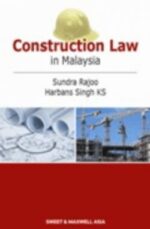
Construction Law in Malaysia
RM368.00This is the first book which deals solely with Construction Law in Malaysia. It is also the first book which discusses the new Construction Industry Payment and Adjudication Act (CIPAA). CIPAA as promulgated by Parliament this year through the intensive efforts of CIDB and related promoters will radically change construction practice in Malaysia.
Authored by two experienced and highly-respected construction law professionals, the book which is written in a clear and concise manner provides an overview of the whole law relating to construction in this country as well as a detailed coverage of many of its important aspects.
It is intended to be an authoritative and invaluable resource for legal practitioners, construction professionals, contractors, developers, employers, students, as well as those requiring an insight into the law and practice of construction law. It supplements the many other books written on various aspects of construction law in Malaysia to date.
The key elements of construction law that are considered include the Malaysian law and its administration, contract law, law of tort, key issues in construction contracts, implementation of construction contracts, financial issues in construction contracts, considerations as to time, suspension and determination, completion and finalization of the contract, construction claims and disputes as well as adjudication.
The book sets out and updates significant new developments in construction law and practice, including coverage of current contract procurement and implementation issues, dispute resolution and recent case law.